botany
The branch on plate 35
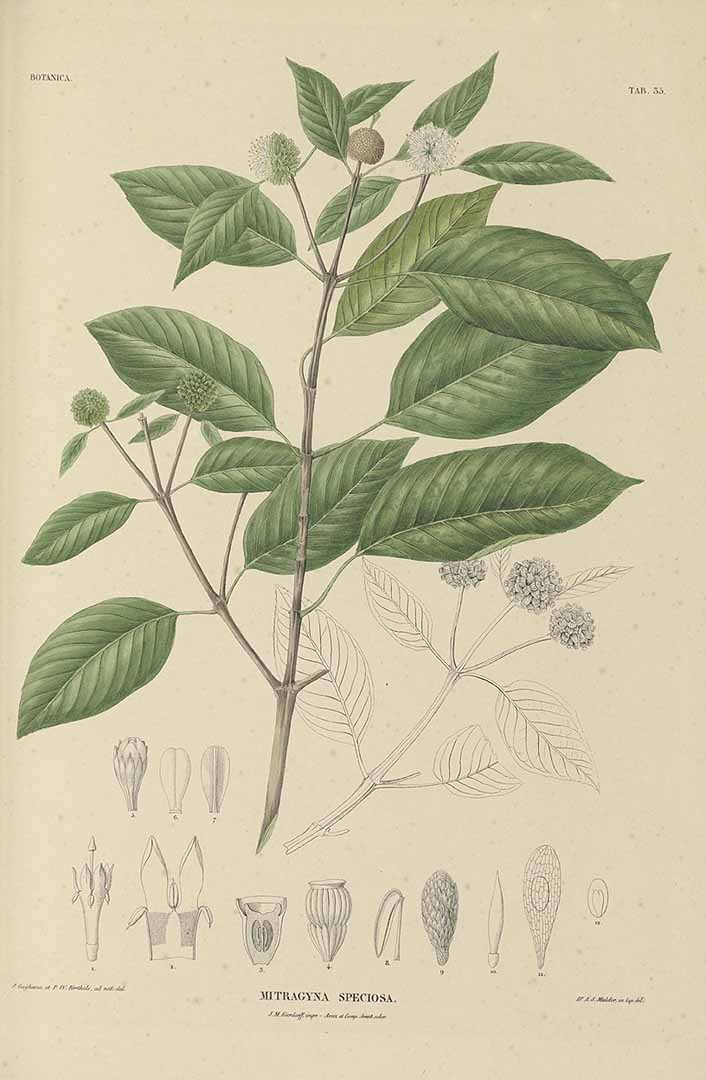
Start at the foot of the drawing. Below a branch heavy with leaves, a row of tiny botanical details runs across the paper. Move back up the stem and you can see some of the same structures in place, barely visible beside a full leaf. P. W. Korthals’s plate 35 lets the eye do something a single photograph rarely allows. You can take in the whole branch and then look closely at its smallest parts without losing your place. Original botanical plate

Four sheets in Leiden
An illustration can gather several views on a single page. Naming a plant raises a different problem. When later botanists disagree about which trees belong to a species, which physical specimen anchors the name?
In his 1978 revision, C. E. Ridsdale referred to material that Korthals had collected in Borneo, held in Leiden. Decades later, a team working on the genus in Thailand returned to that citation. In Leiden there were four Korthals sheets for this tree. Referring to the collection still left a reader with four possible specimens. Ridsdale’s revision, p. 65 · Thai Forest Bulletin, species notes, p. 36
In 2022 Chatchai Ngernsaengsaruay selected the sheet numbered L0000744. The paper gives two reasons. That sheet was in the best condition and matched the old description published under the name Stephegyne speciosa. The technical term for the selected specimen is a lectotype. The authors also identified other original material in Leiden and at Kew. They left open whether those sheets came from the very same gathering. A collector’s name on two labels cannot settle that question by itself. The authors’ account of the selection
Plate 35 and sheet L0000744 reward different kinds of looking. The illustrator gave a reader room to see structures that overlap on a real branch. The botanists gave a future reader an address precise enough to find one particular piece of that tree’s history.